
‘Turn right when others turn left’ – disrupting yachting
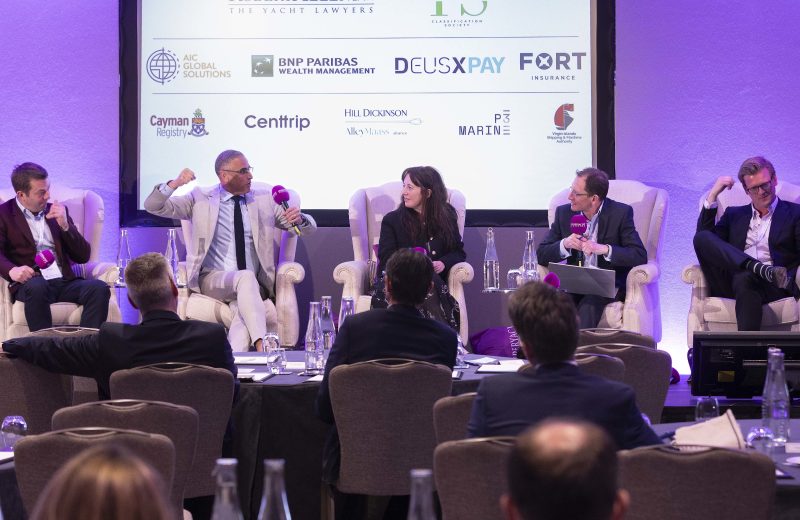
'Disrupting yachting' panel at Superaycht Investor London.
There’s an old gag about a tourist in Ireland who stops to ask a farmer for directions. The farmer peers at the tourist, scratches his chin and then says: “Well, if I were you, I wouldn’t start from here.”
That’s the same sentiment conveyed by Farouk Nefzi, chief marketing officer, Feadship when asked which are the best marketing channels for yachting on a panel about disruption at Superyacht Investor London.
“If that’s the first question you’re going to ask, you’re already starting off at the wrong starting point,” said Nefzi.
“You have to ask yourself, who am I? What’s my DNA? Who is my target group? For whom am I doing it? What is my value proposition? You go through the whole line-up of that before you even start with which marketing instruments you’re going to be using.”
Sign up for the Superyacht Investor newsletter
For Tim Davis, CMO, Burgess, superyacht marketing needs to evolve and become more “client-centric” and “personalised”.
“I’m not sure that as an industry we build our brands around our clients,” he said. “It’s client-focused, but is it really client-centric?
“There are so many other luxury verticals that have been disrupted, and I think it’s coming for us, whether we’re in control of it or not. We have to challenge ourselves.”
WATCH: ‘Disruption in yachting and marketing’
Turning right
Nefzi argued that “disruption is not about being different”.
“It’s about how do you resonate with a certain target group to enable yourself to stand out,” he said. Nefzi highlighted a 2014 Fiat500X car advert that begins with an elderly man who drops a blue Viagra-like pill out of his bedroom window, and which finds its way into the fuel tank of an older model of the car, giving it a new lease of life.
“That’s cool, disruptive marketing because it resonates,” he said. “This industry in particular is very, very conservative in its approach. It’s fantasy-less, without any form of very creative direction. That’s what, for me, disruption means.”
WATCH: Every panel from Superyacht Investor London
He cited the example of Feadship pulling out of its booth at the Monaco Yacht Show last year for ROI [return on investment] reasons, instead hosting an off-site hospitality event.
“If everybody turns left, you turn right,” he added.
Davis was inclined to agree, arguing that “cramming 10,000 people onto a dock and asking them to buy a superyacht is probably not the right way to be doing it”.
‘Scary’
The great disruptor of late is artificial intelligence (AI), and for digital expert Claire Hagen big issues lurk in the area of facial recognition. She explained how facial search tools can be used to identify individuals from their footprint on the internet, telling of how she sat on the top deck of a yacht at the Palm Beach Boat Show and facial software searched everyone walking by, peering beneath the veil of anonymity to identify brokers, bankers and billionaires. And some escorts.
“What does that mean for Monaco Yacht Show, boat shows, client parties, family offices?” she said. “One of the biggest concerns from a survey last year was privacy and AI, because these people are a target for hacking, security, including their kids, everyone’s a target,” she said.
“You can find out a lot of background detail about all these people, which strikes me as being extremely disruptive, particularly if it’s in the wrong hands.”
READ: Brokers on blagging and the art of the deal
Nefzi was keen to flip the narrative on its head. “It’s a scary description but we have to talk also about the opportunities of AI,” he said. “It will enable you to be very, very precise in how you reach out to your target group. The opportunities are equal to the number of risks that there are. It would be ignorant to think that you can leave it aside and not do anything with it because it will lag you behind your competition.”
Davis added: “AI is absolutely a tool to be used to personalise, and the onus is on us; we’re the ones selling.
“We should be personalising every single touch point that the client has with our brands. To me, it might be a magazine, to you it might be online but we should know. AI is going to fast track that but we just have to be careful.”

Henry Smith of Cecil Wright talks strategy at Superyacht Investor London.
Henry Smith, partner and broker at Cecil Wright said businesses need their own strategy to exploit artificial intelligence. He said brokerages that didn’t adopt facial recognition on their stands at the Monaco Yacht Show, for example, would be “behind the times”.
“It means that every single person who walks around that show is going to get found out where they live, where they work and they will be spammed,” he said. “Now, how do you get yourself above that spamming? You write a nice handwritten letter, ask them out for dinner, they reply or not and you go from there. The cost of doing that is pretty minimal.”
‘Powerful place’
Smith agreed with the panel that the industry was “antiquated” but he argued the most disruptive impact on the industry has been “who our clients are”.
“The generation now who are buying these large yachts are very computer savvy and they’re reliant on technology,” he said. “And it’s for us to present these yachts to them in a way that they understand and comprehend.”
‘READ: Mediator, translator, educator’ – the value-add of owners’ reps
This chimed with a key thought from Burgess’ Davis. “If you can sell a yacht without showing a picture of it, then you’re in quite a powerful place,” said Davis. “Because the yacht is essentially just a platform to an experience, whether you’re chartering or owning.
“Increasingly, the best yacht videos are going to be those ones where the yacht might be the last frame of the video. Because potentially, certainly for a new generation, if you start by showing a big white boat, then it can be a turn-off.
“We just need to think quite cleverly about the next generation and how do we engage them. And it might not be yacht first.”
£1,000 lunches
However, Cecil Wright went back to an old-school move to disrupt last year’s Monaco Yacht Show, renting every available billboard space around the city to advertise the 122m Lürssen Kismet which it offers for charter at €3m a week.
“It was deemed such an obvious thing to have done but no one does it,” said Smith. “All advertising is subliminal … but so many people raised it as a talking point, and it just shows how effective it was.”
The horses for courses approach and understanding what you’re trying to achieve as a business is key, adds Smith.
“One of the debates we’ve always had internally is, are you better to spend £10,000 on a double page spread [in a magazine] or are you better off taking 10 clients out for £1,000 lunches?” he said.
“There’s no one silver bullet to it, but getting out from behind your desk and taking someone out for lunch or dinner is definitely a more effective way than just blasting emails around the place and hoping for the best. It’s all about your relationship with these people.
“Differentiate yourself, understand the client, understand what they need and deliver.”
Subscribe to our free newsletter
For more opinions from Superyacht Investor, subscribe to our email newsletter.
