
Globalism, conflict and superyachting

'Has globalism failed?' (Left to right: John Leonida, Robb Maass, Bob Allen, Luca Lanzalone)
Caveats were as common as business cards as speakers at Superyacht Investor London this week tried to sum up the state of the industry against a backdrop of conflict in the Middle East.
The evolving news of widening attacks was never far from the mind on both a human and industry level.
Anders Kurten, CEO, Fraser used the phrase “cautiously optimistic” after his firm sold 12 yachts in 12 days in January. “In a normalised year we would typically have about 50 brokerage transactions above 30m,” he said. “Overall our budgetary projection is cautious growth in all main business areas for the next 12-month period.”
Jamie Edmiston, CEO, Edmiston reflected on his company’s stellar 2025 in which Edmiston posted record sales of more than €3bn (double 2024), including the 118m Feadship Breakthrough.
“Last year was a combination of many years of compounded decisions, strategies and, of course, the great thing you need in this industry, a bit of luck. Luck can compound and hard work can compound,” Edmiston said in conversation with Bob Allen, founder Robert Allen Law, on stage.
“It’s helpful as well to have good clients who want to build big yachts.”
Chris Cecil-Wright, founder of the brokerage Cecil Wright, which specialises in the 60m+ sector, added: “Generally, I’m pretty excited about the future.”
Sign up for the Superyacht Investor newsletter
Richard Lambert, senior partner, Burgess opened the conference with an assessment of the brokerage market. He showed that of the roughly 6,500 superyachts in the world, 67 yachts afloat were sold for more than $100m and 18 sold for more than $200m. The average sale price of yachts sold by the top five brokerage houses since 2020 is €19.4m. The average for the rest is €9.4m. North Americans make up well over half of buyers and charterers.
“Overall we’re seeing the wealth is up over the last few years which is encouraging,” he said. “As long as there’s confidence in the market I think there is a good future for us all.
“Naturally, world events do shape what we do and [with] recent events we might see short-term adjustments in the market but it’s a bit early to tell at the moment.”
Picking up on the numbers, Stuart Wakeling of residence and citizenship advisor Henley & Partners discussed how and where the rich are getting richer. Of the 17 million millionaires on the planet, more than six million are from the US, he said. Eleven US cities are in the top 50 list of the world’s wealthiest containing millionaires. China has the next biggest number of millionaires with more than 800,000. Worldwide millionaire growth is at 78% from 2014-2024. Of 30,000 global centi-millionaires (worth $100m), more than 10,000 are from the US. China is second again with just over 2,000. America also has 867 billionaires, compared with China’s 278. Germany is third with 80.
“The quantum of wealth that has been accrued in the last few years is extraordinary,” added Edmiston.
In terms of wealth migration, of the top 10 wealthiest countries in the world, only the UK in fifth place has seen negative growth (-9%) in the number millionaires between 2014-2024.
Dubai has seen the biggest rises in centi-millionaire growth, owing to its immigration policies and perceived safe-haven location. But recent events have now thrown a giant caveat into the mix.
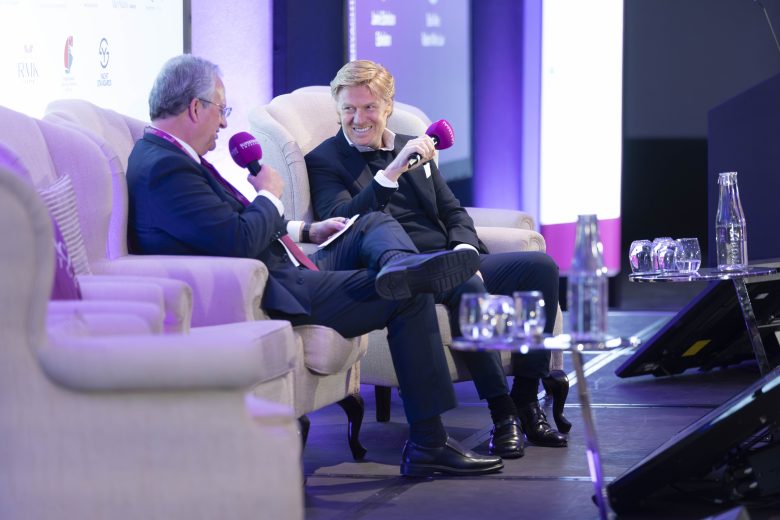
Bob Allen (left) in conversation with Jamie Edmiston.
Which brings us to perhaps the most compelling panel at the conference. Crafted before the US-Israeli attacks on Iran, the session titled “Has globalism failed?” was an attempt to set President Trump’s trade and foreign policies in context to better inform yachting. However, the session took on a heightened edge with robust points landed (respectfully) by both sides.
Laying out the ideology of globalism vs globalisation, Allen suggested Trump’s tariff approach is a “negotiating style” and an attempt to restore balance in favour of the US. American foreign policy is an attempt to mitigate global threats proactively, he said.
Without going into the panellists’ deep understanding of free-market economics, the flat world and the theories of Keynes and Freidman, there were fundamentally different views of how the world should operate. Phrases like “errant nonsense” and “absolute idiocy” were the only slings and arrows.
“Sometimes you have to do things in the short term to achieve long-term stability,” said Allen.
“When Trump got elected the first time, what happened to the superyacht industry? That was the beginning of the boom … it is undeniable that Trump’s policies led to that. Once we get over this hump, unless the world comes to an end, it will happen again.”
But fellow attorney Robb Maass, a shareholder in Florida firm Alley, Maass, Rogers & Lindsay said: “We’ve got to work with others to tackle these difficult international problems.
“We’ve gone from America first to America only.”
John Leonida, a lawyer with Wordley Partnership and an academic historian who is writing a PhD on superyacht history, suggested the growth of yachting only happens when there is certainty.
“What we need is economic and political certainty. That’s not what we’re getting, that’s why globalism gives that to us,” he said.
Maass added: “It’s not money that drives buying and building yachts. There will always be money, there is a world awash in money out there. What determines whether someone builds or buys a yacht is psychological; if you feel good about the world, you feel good about your personal situation, you’re going to buy a luxury asset. If you don’t, regardless of how many billions you have in the bank, you won’t. So stability is key … we are in a much more uncertain world today than we were even a year and a half ago and that’s a negative for the yacht industry.”
Allen described Maass as the “dean” of superyacht lawyers but vehemently disagreed. “The bottom line is everybody here works in the industry that builds big boats and Americans are going to buy big boats,” he said. “They’re going to keep building big boats and they’re going to trust the Americans to pay for the big boats. So what else do you want?”
Maass said he wanted a world which “works together towards common goals”. “There you go, the utopian,” said Allen.
But they hugged at the end and the audience set off for lunch with much to ponder.
Our thoughts remain very much with those affected by conflict.
Subscribe to our free newsletter
For more opinions from Superyacht Investor, subscribe to our email newsletter.
