
Poacher to gamekeeper: Cashman on scale vs value
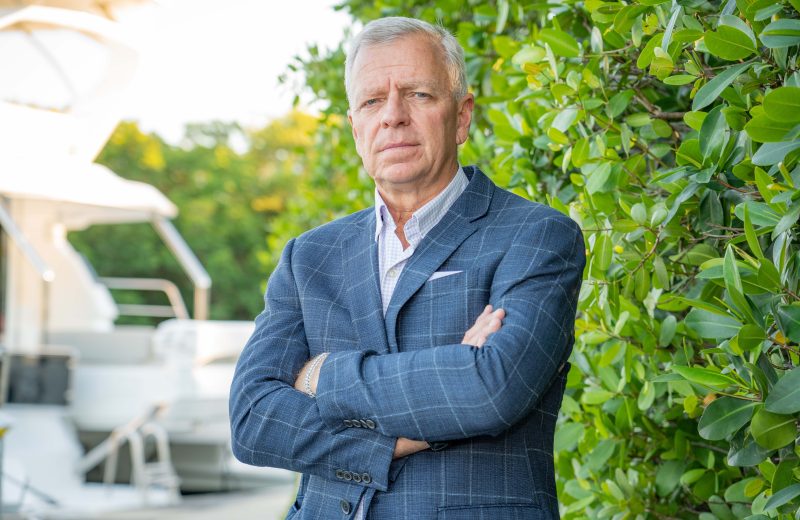
Chuck Cashman is vice president global sales, MarineMax.
He’s been a poacher, now he’s set to be a gamekeeper. Or the acquirer becoming the acquired.
Chuck Cashman was instrumental in MarineMax’s acquisition of both Fraser Yachts and Northrop & Johnson. But now he faces the prospect of a proposed $1.5bn takeover of MarineMax by the Blackstone-backed marina operator SafeHarbor
He can’t talk about it yet, but Cashman acknowledges there will be an element of managing both up and down.
“Everyone has a boss,” Cashman, MarineMax’s senior vice president of global yacht sales tells us.
He adds: “What I can say is that the two groups together are about 7,500 people, both with a cultural goal to take great care of the customer. Honestly, it’s going to be an amazing acquisition. I look forward to talking about it once it’s done.”
SIGN UP for the Superyacht Investor newsletter
It’s a hot topic given the circling of private equity around yachting – think Ancient Capital’s recent acquisition of Burgess – and the dynamics involved between corporate overlords and superyacht brands trying to retain their distinct identities.
When Cashman was appointed to his current role from his previous position as chief revenue officer in October 2025, MarineMax CEO Brett McGill praised his “strategic leadership and relentless focus on growth”. It was this that led Cashman to push for the acquisition of Fraser Yachts. To find out what motivated him, you have to go back to the start. He was recruited from real estate by Bill McGill to work as a salesperson in the original Gulfwind Marine store in Florida. Showing prowess, one store became two, as the juggernaut that would become MarineMax gathered pace.
“As we move forward through the history of MarineMax, we got really good up to 100-120 feet. And then we would lose that client. Nobody in the world thought we were the big boat people. And that is a definite example of determination, vision and strategy to say, ‘Look, we need to be in this segment,’” he says.
The risk with something like that is, you’re buying people
Cashman, though, realised pure brokerage wasn’t enough. “What I’ve learned through 34 years [in the industry] is, we want to do it all,” he says. “And not because we’re greedy. It’s because we want to take the friction away for the client. And if we can take the friction away, everything else takes care of itself.”
When the timing was right and the stars aligned, MarineMax acquired Fraser Yachts from Italian yachtbuilder Azimut-Benetti Group, led by Paolo Vitelli, in 2019.
“We were extremely happy with the Fraser acquisition,” he says. “The risk with something like that is, you’re buying people.”
As MarineMax paused for breath to work out what it had bought, it was offered the chance to acquire another brokerage, Northrop & Johnson. Initial reluctance turned into open-armed enthusiasm.
“We fell in love with their people, more than the business. We liked the leadership. Founder Kevin Merrigan connected with us on a really good level,” he says. The original thinking was to combine the two brokerages into one.
“As we got to know the people and the customers, we realised they’re really different,” he adds.
Pockets of performance
The MarineMax team conducted a deep dive into both brands with an expert firm in London. After data gathering and conversations with team members, customers, competitors and the industry at large, the recommendation was that the time was not right to bring the companies together. They also analysed the two companies’ databases, expecting a commonality of about 25-30%. The findings revealed there was only a 2% overlap in clients. “Are you sure?” asked Cashman. They ran the study again to double check and got the same result. “You could have knocked me over,” he adds.
“The people who wanted Fraser went to Fraser, the people who wanted Northrop & Johnson went there.”
We are as safe as a bank. Customers like that.
Back-office functions were combined but the strategic decision was to retain brand identity.
“If we homogenised them, we risked losing the customer that was looking for one or the other,” adds Cashman. “My boat is called ‘Never Say Never’ for a reason. We may decide at some point that they’re better united than apart but right now, we like what we’re doing. Both companies are performing. Both have nuances and pockets of performance that outshine the other.”
Understanding those subtleties is key.
“Everything we try to do in our business has to have a benefit for the customer,” he says. “There’s no benefit that I can see for the customer just to say we’re the biggest.
“But what we can tell them is that whatever your needs are, we can align you with a company best suited to serve them. And that formula works.”
The policy is not to impose MarineMax on the businesses, but it proves a useful comfort blanket, suggests Cashman.
“It’s not Fraser by MarineMax,” he says. “But customers like knowing that there’s a MarineMax behind the scenes. They love knowing that if they give me a $5m deposit, I’m not making payroll with it. That’s where MarineMax adds value to a Fraser and Northrop and Johnson. We are as safe as a bank. Customers like that.”
‘Hunters not nurturters’
In terms of how the two superyacht brokerages fit with the rest of Marine Max’s portfolio, which includes recreational boat builders and retailers, yacht services, IGY Marinas and a number of digital retail and lifestyle platforms, Cashman says: “They layer on very nicely at the upper end of what we do because it’s a low-cost, high margin side of the business.
“They really help us with our overall gross profit. They don’t have inventory, they’re capital light. So they help our margin probably more than they help our bottom line.”
There’s very little I like more than selling
Talking generically, Cashman suggests private equity can be a “good thing” if the motivation is right, perhaps if a company is constrained for growth because of a lack of capital. “Imagine somebody with real money approaching a boutique broker and saying, ‘Hey, I like what you’re doing. You want to do it for another 20 years? Let me help you get there faster’. That could be amazing,” he says.
“But if it’s an exit strategy for the principal, then beware.”
That’s especially true if a successor has not been well groomed for the role, he reckons.
“There’s not layers of talent in our industry. It’s an ocean that’s one inch deep,” says Cashman.
“You’ve got to have the appetite to carry people when you’re a leader. Sometimes people who build these amazing companies are mavericks. They’re hunters, they’re not nurturers.”
Changing expectations
Cashman, on the other hand, gets his purpose from developing people.
“What I like more than selling, and there’s very little I like more than selling, is building a team,” he says. “I like being part of a team, although in fairness, I like leading the team.”
While much has changed since he joined the industry, Cashman is adamant the core essence of yachting remains the same.
“It is the same raw emotions that causes a person to buy their first boat, maybe a 20ft lake boat, or to build a 100m boat,” he says. “The wealth is different, the commas are different, but at the end of the day, it’s the desire to be on the water with your friends and family.”
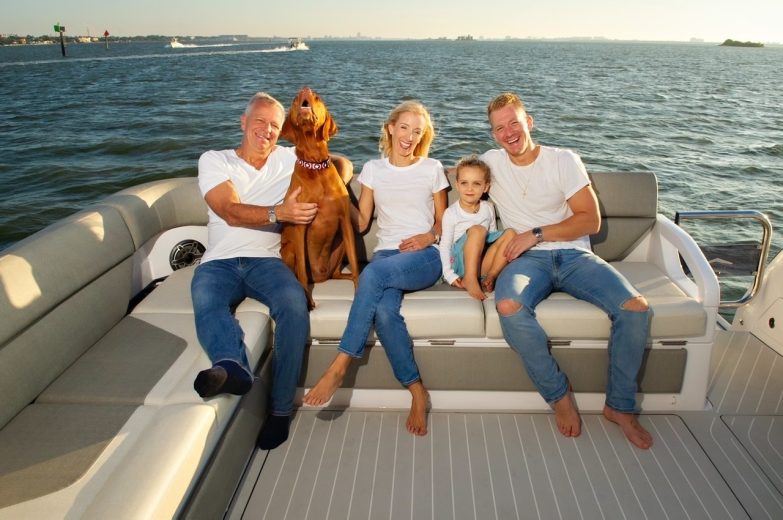
Chuck Cashman and family.
What is different, he says, are expectations and attention spans.
“One of the things that has changed dramatically in all segments, is that the desire of ownership has changed. The drive to be on the water with friends and family, doesn’t always have to translate to ownership now. The $1m weeks that we charter now are more than they’ve ever been in history.
“Twenty years ago that was inconceivable. Why wouldn’t you just buy it? Back then, guys like me, we wanted to own things.”
Luckily, there are still plenty of people who do want to buy, build and own but the “uptick in big charter” is often because clients want the experience, not the “friction”, says Cashman.
“You’re seeing houses worth $10m renting on Airbnb,” he adds. “A great example is my son who was thinking of joining a golf club. Instead, for the same money him and his buddies went to Scotland and played all the great golf courses for two weeks. It’s much more transient. It’s a difference in the generations.”
Candidly, Cashman admits his ego drives him to succeed, for his clients and his people.
“I’m driven for achievement and it doesn’t have to be mine. I love helping people put deals together,” he says. “I’m very, very passionate about the customer experience. I want customers that have an amazing time. We take care of the customer, take care of the team. Everything else takes care of itself.”
Subscribe to our free newsletter
For more opinions from Superyacht Investor, subscribe to our email newsletter.
