
Munro: Nuclear ‘100% the future’ barring perception
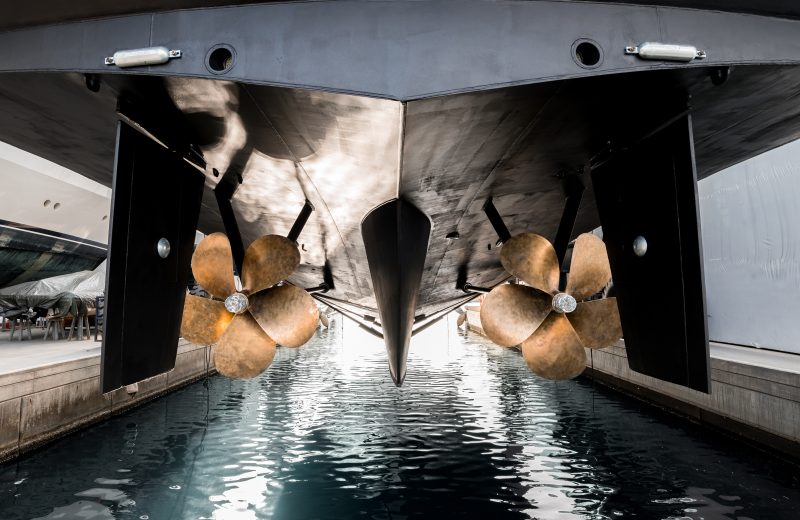
For four years they referred to it simply as the “power pack” to avoid prying ears getting wind of what they were up to.
It was easy for Derek Munro. He kept even his wife in the dark about the building of revolutionary sailing yacht Black Pearl until someone in his village showed her a picture of a vessel being launched in Amsterdam. Only at that point did he confess.
Now the new-build consultant and director of Divergent Yachting is able to talk about his work with a small team pushing a nuclear solution for superyachts, which he calls “100% the future”.
Under a collaboration named NOxFree, Munro and colleagues David Lewis of Laurent Giles Naval Architects and former Royal Navy nuclear submariner Steve Rasmussen of Rasmussen Marine Services are working with the producers of a 1MW nuclear small modular reactor, known as the “Unity Module”.
With regulatory approval, they hope to be ready to install the technology in yachts over 40m by the early 2030s.
“This is far safer than hydrogen and ammonia and as power density goes it’s better than methanol. This is the future,” he says.
“We’re not talking a massive 20MW unit that needs shields and concrete all around it, it’s a totally different concept.”
Profound impact
The project began in June 2021 when a client asked Munro to explore the feasibility of nuclear power on a yacht.
“We worked very quietly in the background and handed him a 287-page feasibility study on the first day of the Monaco Yacht Show,” says Munro. “A few weeks later he came back and said, ‘Let’s go, let’s do it’.”
They have visited manufacturers in the US and worked closely with Lloyd’s Register, the UK’s Office for Nuclear Registration and the International Maritime Organization (IMO).
“Small nuclear units for superyachts are no longer a distant vision – they are emerging as a credible option for the industry,” says Engel-Jan de Boer, global yacht segment director, Lloyd’s Register.
“Advances in modular nuclear technology, particularly in safety and scalability, could enable virtually unlimited range and zero-emission propulsion for large yachts. While regulatory frameworks and public perception remain critical hurdles, the potential impact is profound: nuclear-powered superyachts could redefine sustainability, autonomy and luxury in yachting.”

Public perception
Alongside the nuclear work, NOxFree has been developing super capacitor graphene batteries, already used in some land-based mining operations and data centres, which could achieve maritime regulatory approval by January.
“Last year I was researching the upgrade for the lithium-ion batteries on Black Pearl and discovered these, which have an incredibly long life, can be charged multiple times, are non-combustible, non-flammable, don’t need any fire protection systems and are very safe,” says Munro.
Used in conjunction with the nuclear concept, the team foresees a fossil-free future for yachting.
“We’ll be able to build, from 2030 onwards, a vessel that has zero fossil fuel onboard, which for us is very exciting,” he says.
“But public perception of nuclear energy is our biggest challenge. We’ve got 3-4 years to advertise, to educate, to meet people and try to get people to change their minds.”
Matteo Magherini, head of North Europe Yachting Centre for classification group RINA says nuclear is having a “renaissance” and predicts the first privately owned, nuclear-powered vessel will be operational during the next decade.
“For the superyacht sector, adoption may follow a similar trajectory,” he says. “Owner-driven projects, combined with higher tolerance and true passion for technical risk vs innovation, position large yachts as potential early adopters. Nuclear propulsion may represent a game changer: energy density is millions of times greater than diesel fuels, enabling large yachts back to higher top speeds, range and surplus energy on board to power or recharge amenities and beyond.”
Disco Volante
Munro explains that the modules, using 5% low-enriched uranium, are housed in 20ft containers.
Two of these in a 60m yacht would replace two engines, two or three large generators, an emergency generator, all of the exhaust systems and exhaust scrubbers, all of the fuel separators and all of the fuel tanks, plus the large ventilation ducts for ER air which commonly run through the interior.
It also removes the need for maintenance every 600 hours and major services every five years.
Run on land at 100% 24/7, the unit would last about 6-10 years, says Munro. But given the sporadic nature of yacht usage the life would be far greater. They could last up to about 40 years if the yacht spends most of its time tied to the dock ticking over at 15-20% of its power utilisation, he adds.
“You could sell the excess power back to the marina or shipyard or you could charge the batteries on the boat next to you,” he says. “More importantly, it’s clean.”
At the end of its life, a specially designed “soft patch” in the yacht will allow the container to be removed and replaced with a new one. Some 95% of the unit will be repurposed with 60% of the uranium repurposed.
“We’ve got 3-4 years to advertise, to educate, to meet people and try to get people to change their minds,” he says.
Over the years they have dreamed up “umpteen” variations of how the concept might work in practice, including recreating the Disco Volante yacht from the James bond film Thunderball, which had a detachable front section.
“We showed a client an option where the battery part could go into port and the nuclear part stayed at anchor,” says Munro.
“We’ve had four years to play around with it. It’s been fun.”
Munro says they have concept drawings for designers with suitable clients, ranging from 60m to a 118m concept.
“This is one build cycle away,” he says. “If you want to be in on the first ones in 2029/2030 you need to be designing it into your project now and in the next six months.”
The team are now researching the feasibility of installing the turbines and the “back end” without the nuclear pack which can be installed once it is available. They’ve also had to identify shipyards in nuclear-friendly countries and work out how to drive or tow the yacht to another country to have it installed.
Another practical issue will be the limited locations a nuclear yacht could be used initially, owing to regulations.
“The biggest hurdle is where they can take it,” he says. “You’ll be amazed how many places you can take it in the Pacific, the Caribbean, the Mediterranean. It won’t be Monaco or St Tropez to start with but it will be in the future because they are safer and greener than generators and diesel engines.”
Munro’s response to critics is that their research is unlikely to be up to speed, while De Boer suggests successful adoption will require “clarity, collaboration and trust” among all stakeholders, including society at large.
Magherini adds: “If I have learned one lesson in yachting it is that with the right budget and a strong willingness, about anything (except breaking the laws of physics) can be done.
“In this context, large yachts could act as demonstrator platforms for wider nuclear adoption across the maritime sector. Continued public education and early-stage deployments will be critical to enabling broader acceptance.”
Subscribe to our free newsletter
For more opinions from Superyacht Investor, subscribe to our email newsletter.
