
Broking’s Catch-22 & endangered species: Tucker
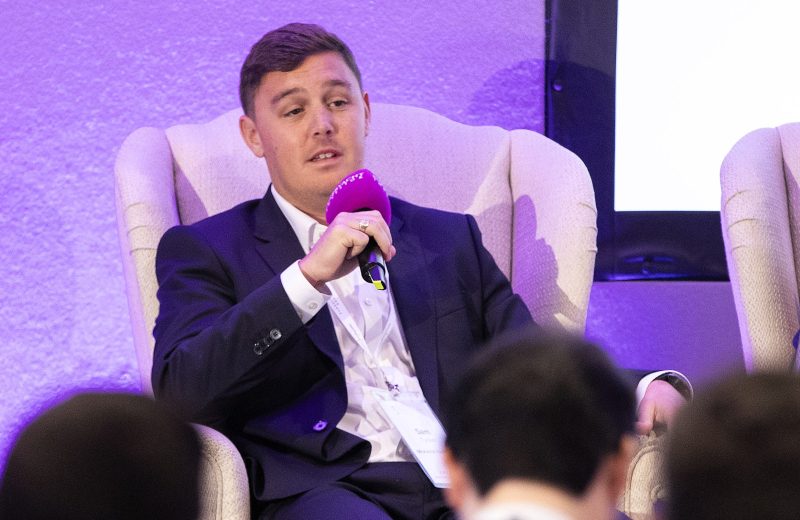
Moravia Yachting's Tucker speaking at Superyacht Investor London.
In the Catch-22 of the famous novel, you couldn’t fly if you were crazy, but you had to be crazy to keep flying. If you asked not to fly it proved you were sane and so you had to fly.
It’s similar with yacht brokers and off-market deals, especially for young brokers trying to make a name for themselves. If you can’t talk about the 100-metre yacht deal you’ve just done, how are you going to convince anyone you are the right person for their 100-metre deal?
Sam Tucker, a broker with Moravia Yachting, knows this all too well. It’s a case of having a better track record than it looks on paper. Publicly, anyway.
“It is a bit annoying, but equally if I ever get nervous before a meeting I just say to myself, ‘Hey, if you can do a 100m, you’re fine. Back yourself,’” he tells us. “It gives you the confidence.”
Sign up for the Superyacht Investor newsletter
Tucker, who has been a broker for three years, has just listed his first Feadship, the 64m Lady Marina, in partnership with veteran US broker Merle Wood, as well as the 89m support vessel Sky. Both are garnering plenty of inquiries.
“They are two serious bits of kit. For my own personal PR, it’s fantastic,” he says.
Tucker has plenty on his plate with other “very discrete” projects and senses the market in general is “pretty active” despite the usual summer slowdown. More certainty in the world following the initial shocks of US tariff threats could be one driver, he suggests.
“Personally, I’m busy,” he says. “But if you take a poll of all the brokers in the world, I don’t know that everyone will be saying the same thing.”
He adds: “It’s one thing being active, but it’s another thing actually getting deals done. Of all the work you put in, it’s knowing what’s the 10% that will result in money. But you get a few big wins under your belt and it’s all worth it. And it takes you off the endangered species list.”
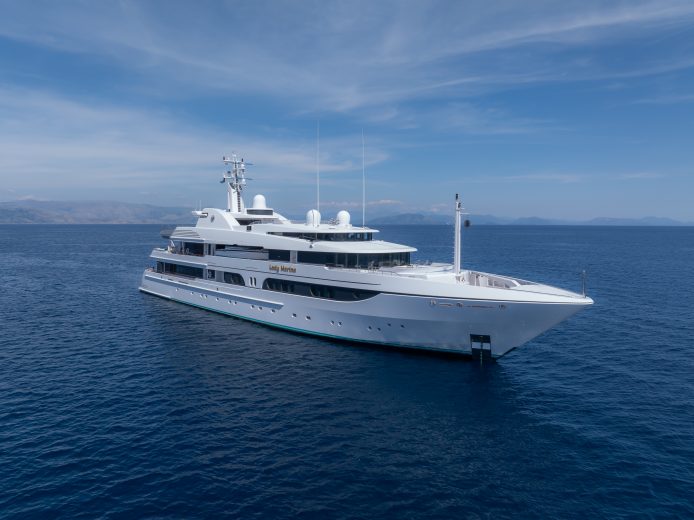
Tucker’s first Feadship listing is the 64m Lady Marina.
Tucker joined the world of brokerage with rock-solid credentials. He studied naval architecture at university before crewing on renowned sailing yachts such as the J-Class Velsheda and the Wally Cento Galateia. Moving ashore he worked for Vessels Value in its then yacht department in London, building a computer model to value superyachts.
“To do that, we had to know as much as possible about the market. Who’s who, what’s what, how does it work?” he says. “So we were capturing every new listing, every price reduction, every asking price change, every sale.”
Towards the end of his five-year stint he became the front man, selling the product to clients. The move to brokerage was a natural progression.
“I knew the yachts, I knew the market, I enjoy people. The only thing I didn’t have was this black book of clients,” says Tucker, who is based in Palma, Mallorca.
READ: Refit a ‘critical asset’ for Palumbo Superyachts
Gaining the trust of wealthy prospects was the issue in the early days. “One of the biggest barriers was just my age and my gravitas,” he adds. His first time showing clients around a yacht was at the Cannes show but Tucker says he was a bag of nerves “completely overthinking it”, trying to be charming and chatty while making sure everything was perfect. “They didn’t end up buying the boat, surprisingly, but you have a few false starts,” he laughs.
His first sale a couple of weeks into the job “landed on my lap”, an auction of a £100,000 boat passed on from a lawyer he knew from Vessels Value days.
“I got less than £5,000 but the elation was just fantastic,” he says.
With experience comes confidence, allied to a strategy of “knowing as much as possible”, says Tucker. Having Moravia parent Hill Robinson’s array of experts on the end of the phone is a “massive benefit”. He also tries to learn from the “old guard” of brokers but reckons it’s important to have your own vision rather than taking their ways as “gospel”.
Lowball
Given his background, Tucker has a keen sense of valuations and acknowledges asking prices are “always inflated”. But he has seen from the low offers coming through recently that there are plenty of “vulture buyers” in the market. “People are waiting for blood in the water,” he says. “But the sellers, unless they are desperate, are not taking the offers. So I am seeing quite a big spread.”
His advice to sellers is generally to get it done quickly. Hanging out for a year for a higher offer comes with the risk of no better bids, plus depreciation and running costs in the meantime.
“The game is to push the buyers up and push the sellers down to try and make something happen,” he says. “If you go in and lowball someone, it just costs everyone time. And as a broker, if you’ve got to fly out every time or go into the sea trial or have all these expenses, every round of negotiation is more money.”
He suggests that it is often the clients with more time on their hands who are the ones testing the sellers the most.
“They kind of sadistically enjoy the process of making brokers go grey,” says Tucker. “I found my first grey hair the other day. It was very sad.”
‘A bit excited’
As well as the successes, Tucker has been in the game long enough to take some hits along the way. There was the time the contract was signed and the client asked about sizes for crew uniforms. The client was due to fly in his private jet from North America to the Mediterranean to complete the deal. Tucker saw the manifest which even included the client’s dogs.
“I thought, ‘OK, great, he’s definitely coming,’” he says. “And then he disappeared completely. He just didn’t pay his deposit. I was like, ‘Why are you asking about the crew uniform size? This is step 20 of the deal, or post deal.’”
READ: Oceanco acquired by US tech mogul Newell
Another time a client got cold feet because the certificate of registry said the yacht was “built in carvel”. In yacht construction that’s where planks are abutted end-to-end on a frame, rather than overlapping. But the client’s team complained that Tucker had told them it was built in a certain country, rather than in carvel. No amount of explaining would convince them and they pulled out, citing a loss of trust. “That was rather annoying,” he says. “But to be honest, if clients are that flaky, maybe they wouldn’t have bought it anyway.”
Tucker’s coping mechanism is to remain “stoic”. “You have to trust the process and stick at it,” he says. “You can’t get too upset or too excited.” But therein lies another catch. Remain too unmoved and you’ll likely underperform. Too much the other way and the disappointment could be crushing.
But he adds: “You need to get a bit excited otherwise what’s the point?”
Subscribe to our free newsletter
For more opinions from Superyacht Investor, subscribe to our email newsletter.
