
Skeletons in the hull: Pendennis’ Ross on rebuilding classics
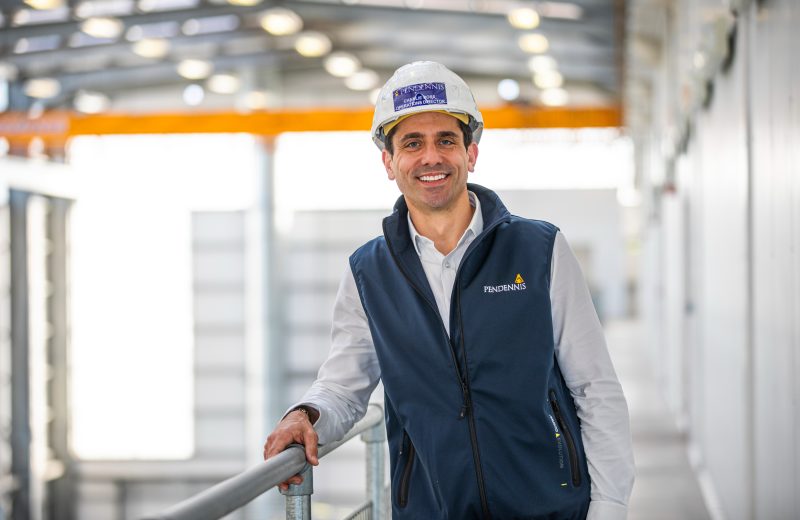
Charlie Ross is group operations director, Pendennis.
She is a classic motor yacht from 1931 but Marala’s storied history hid some dark secrets.
The Camper & Nicholson-built vessel was converted for naval service in World War Two and went on to host royalty and celebs such as Salvador Dali and Frank Sinatra.
But it was in her hull where the skeletons lay.
Her new owner in 2016 engaged Pendennis, the Falmouth, UK shipyard to carry out a sympathetic restoration and upgrade. One job involved modifying a space under the engines to fit some new pipework. But in chipping away what was “probably the best part of a hundred years of paint” the team discovered the hull needed significant remedial work.
“With some of these older vessels like Marala, Odyssey III and Haida 1929 you get into the work, and you find emergent work such as corrosion,” says Charlie Ross, group operations director, Pendennis.
“The next thing we know we’re supporting both of Marala’s engines off structures off the dock floor and we’re trying to rebuild the whole of the bottom of the boat with the engines in place.”
Sign up for the Superyacht Investor newsletter
More than 100 tonnes of steel was renewed, mostly on her hull, alongside comprehensive internal and external modifications.
“Fortunately, they are a wonderful pair of owners who understand the foibles of owning a vessel built in 1931 and what they’d taken on,” adds Ross.
“Time wasn’t their driving factor; it was through Covid so there was opportunity to work on solutions. Every project is different and have their own drivers.”
Marala went on to win the best rebuild category at the 2023 World Superyacht Awards.
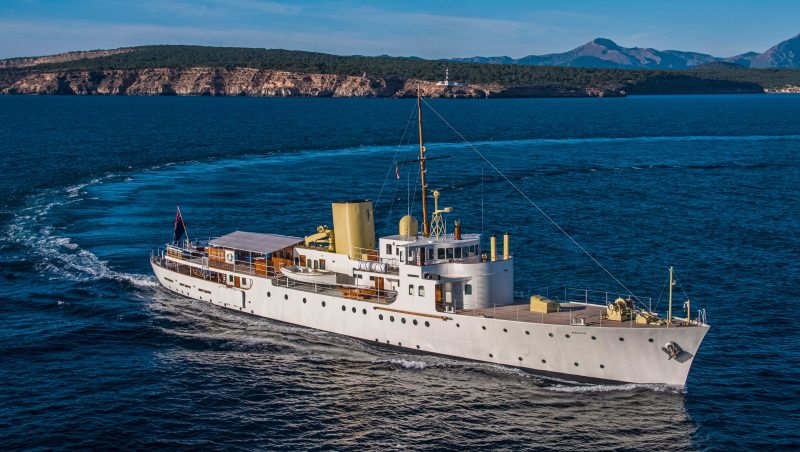
Marala hosted stars such as Salvador Dali and Frank Sinatra. (Photo: Yacht shot)
Pendennis was also engaged to “bring back to life” the 69m explorer yacht Jester, an old hydrographic survey vessel which had undergone a previous conversion.
The initial scope was an interior refresh, review of the engineering systems and a repurpose of the exterior spaces. But as work and conversations progressed, the project evolved into “something quite different”, including a change from private to commercial registry.
But Pendennis, founded in 1988, has completed more than 350 refit, rebuild and restoration projects and is skilled at navigating the “tightrope” between upside and risk, according to Ross.
“From the outset in the spec or scope early on, you have to be clear which elements we’ve got the risk on, which elements we’re sharing the risk, whether that’s cost and time, and which elements may have to be noted as an investigation to start with. Because until someone pulls something apart or does a piece of work, the scope can’t be known,” he says.
“And then there’s probably then a fourth category called the unknown unknowns, which no one knew about and no one was expecting.”
READ: Inside the Feadship sales psyche
When the scope of work grows unexpectedly on projects, there are often some “difficult conversations” to be had with clients around what that means in terms of increasing cost and time.
“Probably the latter is a harder pill to swallow,” adds Ross.
Despite the challenges, Pendennis completed its work on Jester in under two years and continues to support the owner with other projects.
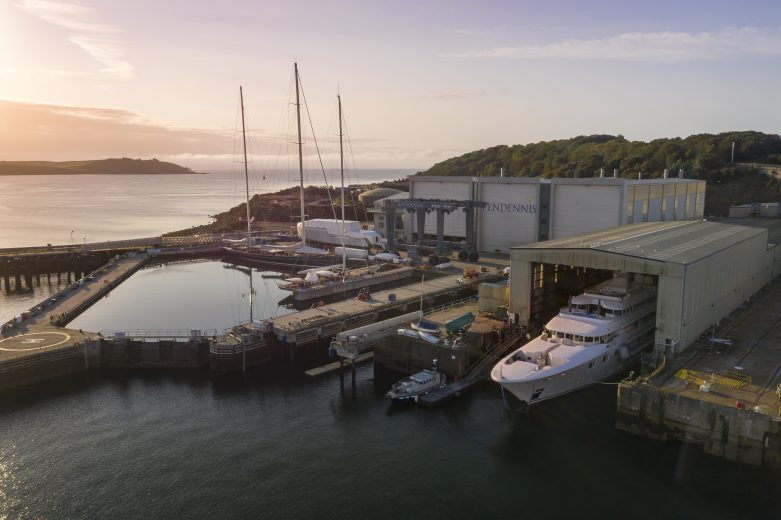
Pendennis’ Falmouth base has a rich maritime history popular with clients.
One of the yard’s recent projects has been Seawolf, a 1959-built ocean-going tug converted into an expedition yacht. After a significant refit completed in 2024, it returned for a second phase of work including fitting lithium-ion batteries and commissioning a hybrid diesel-electric propulsion system. According to Ross, the lessons learned were some of the most significant in terms of “incorporating modern sustainable solutions into existing vessels”.
“On any project there are sometimes bumps in the road, but when you’re doing everything openly and sharing the challenges and making sure there’s no stones unturned in terms of solutions and getting them into service as quick as possible, then actually you form a relationship that lasts,” he says.
“There is upside to that kind of work, but there’s also plenty of risk that needs to be managed in terms of the right contracting arrangements, the right mechanisms around time and how that’s layered into the contracts and expectations of the owners as well.”
READ: Hot or not? Market forecasts for 2026
Following a £22m ($29.8m) investment, Pendennis’ Falmouth base has a 150m dry dock, plus two 90m and one 40m construction halls, alongside a full suite of shipyard services and more than 550 skilled employees. It caters for regular maintenance and refits, larger scale rebuilds and 30 bespoke new-build yachts to date, with a “sweet spot” of below 50m. The 34.86m explorer yacht Fox, delivered in 2024, is a recent example.
“We don’t really want to put all our eggs in one basket,” says Ross. “We try to take a blend of work, so if there’s a new build of the right product mix that suits our profile at the time, then we would also entertain that.
“There are well-informed owners out there that can assess the price per gross tonne of where they would enter into a new-build scenario versus breathing life into something that’s already in existence.”
Pendennis also operates a service centre in Vilanova, Spain and Ross describes business there as “incredibly strong”.
“The challenge is securing the bigger works,” he adds. “Having the competition in northern Europe, that’s who we’re up against when we’re tendering.”
READ: Nuclear ‘100%’ the future barring perception issues – Munro
Pendennis’ location in Cornwall in the far south-west of England is not without its geographical disadvantages, notably for suppliers, but Ross insists the positives far outweigh any negatives and are a major draw for clients.
“It’s enormously helpful, especially when US clients come here, that they can see the history,” says Ross. “They can step into Henry VIII’s Pendennis castle. They can see the natural harbour where the packet ships pulled up, they can see the heritage in terms of maritime activity. And it’s a beautiful coastline with the Isles of Scilly nearby.”
Mindful of the lack of marine hub in the region, Pendennis opened an apprenticeship scheme in 1998 which takes on up to 20 people a year. The programme has produced generations of skilled tradespeople, supervisors and senior managers who now form the backbone of the business.
“For a long time we’ve realised that we have to grow our own talent,” says Ross, a chartered naval architect and former marine surveyor for Lloyd’s who himself relocated to Falmouth as a project manager for Pendennis in 2006.
“Because it’s a nice place to live we also get the benefit of people relocating with the right skills and capabilities later in life.”
According to Ross, Pendennis has some further “quite cool” investment plans for both Falmouth and Vilanova involving “some optimisation efficiency” and a “little bit of growth”.
As far as dealing with clients is concerned, his advice is succinct: “Don’t take anything for granted and deal with each client as an individual. And listen.”
Subscribe to our free newsletter
For more opinions from Superyacht Investor, subscribe to our email newsletter.
