
Storms, sirens and the order book
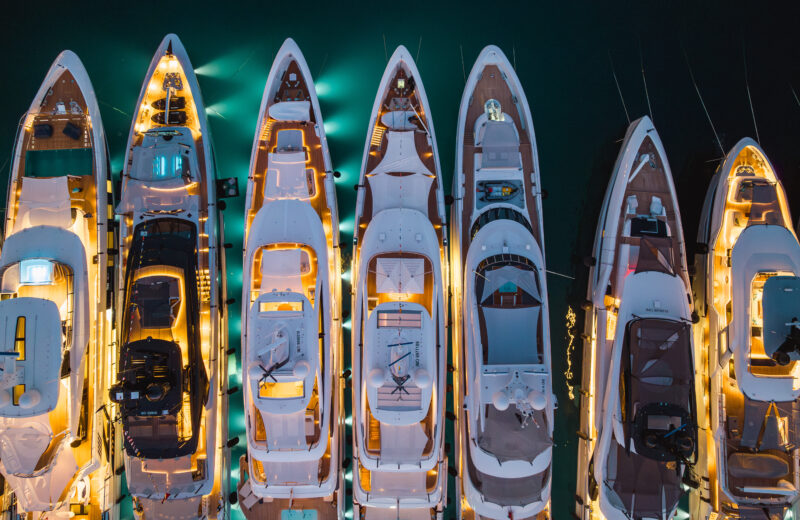
Aerial view of superyachts. Photo: Monaco Yacht Show
There have never been more ultra-wealthy people and fewer of them are ordering superyachts. Oliver Scharping argues that the bottleneck going into 2027 is not money but the way families decide.
Here is a puzzle. The world keeps producing very rich people: Knight Frank counts about 714,000 people worth more than $30m, up from roughly 551,000 in 2021. Altrata reckons the ultra-wealthy population grew by 14.4% last year alone. You would expect more people who can afford a superyacht to mean more superyacht orders. Instead, new-build sales fell by around a fifth in the first half of the year, the fourth straight first-half decline according to Northrop & Johnson. BOAT International’s global order book has shrunk for three years running.
SIGN UP for the Superaycht Investor newsletter
The brokerage numbers are odder still. Northrop & Johnson counted 326 pre-owned sales in the first half, 8% fewer than a year earlier, yet the average boat sold for about a quarter more. The 100m Feadship Moonrise came to market at €325m and found a buyer in 159 days. Ocean Independence found that the median yacht over 30m took 392 days to sell, with more than 70% of deals involving at least one price cut. So the top of the market is fine, the rich are richer than ever and nearly everybody else is waiting.
I opened a talk in Monaco in September by arguing that this is not really a money problem. Odysseus, you will remember, did not lose his fleet to the sea; he lost it to decisions taken badly, at speed and far from home. A superyacht has to clear three books in turn: the financial book that pays for it, the family book that consents to it and the lifestyle book that carries it for a decade. This year the first two are being repriced at once and the third is waiting politely for them to finish.
The financial book
Start with the money, which is less simple than it looks. Early this year, a UBS survey of 307 family offices found that a record 60% planned to change their strategic asset allocation, 56% feared a debt crisis and 65% expected a weaker dollar. The year has since been unkind to at least one of those views. Brent is back above $100 on the Iran war. Inflation has returned, at 3.7% in the US and 3.8% in the euro area in September, so the Fed and the ECB are raising rates instead of cutting them. And the US 10-year yield has touched its highest level since 2002. Gold sits about a quarter below its January record and the dollar, far from collapsing, is stronger against the euro than when the year began.
Each of these lands somewhere specific on a yacht. The yard contract and the running costs are probably in euros, while an American owner’s wealth is in dollars, so the owner is running a currency position, intended or not. This year that has favoured dollar buyers, for whom a European-built yacht is about 7% cheaper than at the euro’s January peak. Sanlorenzo’s first-half revenue from the Americas rose 35% while Europe’s fell 17%. The war shows up in the accounts too: Ferretti booked no superyacht orders at all in the first half and cut its guidance, citing the Middle East.
Then there is the illiquidity budget. UBS’s families already hold 42% of their portfolios in alternatives and the private-equity machine is handing it back slowly. Jefferies puts distributions at about 10% of net asset value a year, against a long-run average of 25%, which helps explain a record $118bn of secondary trades in the first half. A superyacht competes for the capital a family can afford to lock away and most of it is already locked away somewhere else.
The family book
The second book is about who gets to say yes. Some 57% of UBS’s families have a succession plan for their wealth but only 35% have one for the family office itself. In Europe almost a third of heirs old enough to take part in decisions are not involved at all. Politics presses on the same question, from California’s billionaire-tax ballot to Germany’s inheritance-tax case. The person who signs for a yacht in 2026 is increasingly not the person who decides its fate in 2036. That heir has been taught to ask for evidence, transparent economics and an exit. “Let’s revisit after the summer” usually means one of them has not yet agreed.
The lifestyle book
The third book is the one this industry knows best. Running costs are commonly put at 10-20% of a yacht’s value a year and the priciest recent lesson in the subject was taught to the US government, which seized Amadea in 2022 and spent about $32m, roughly a million dollars a month, keeping her until she was sold last year. Any owner could have told it that for free.
Professional investors have reached a sensible conclusion: if owning the boats is complicated, own what the boats need. Blackstone-owned Safe Harbor has agreed to buy MarineMax, brokers and marinas included, for about $1.5bn, and InfraVia is buying the D-Marin marina group for a reported €1bn-plus, six years after CVC paid around €200m for it. You may struggle to persuade a family to commit to a hull, but you can certainly charge it for parking.
The brokers and yards who do well in 2027 will treat the sale as a governance exercise, bringing the financing, the currency and the exit to the first meeting and asking early who else has to agree. Odysseus lost every ship and still got home, because what he was protecting was the household rather than the fleet. The families who sign next year will be those whose households are in order.
Oliver Scharping, senior advisor & private banker, is based in Monaco and is an adjunct professor at various European business schools. His recent research focuses on family-office governance.
Subscribe to our free newsletter
For more opinions from Superyacht Investor, subscribe to our email newsletter.
