
Surveying the State of Yachting
If the job of dishwasher in a restaurant could be dressed up as “ceramic technician” so the role of yacht broker could be known as “confidence deliverer”.
That’s (broadly) the view of Chris Cecil-Wright, founder of boutique large yacht brokerage Cecil Wright, speaking on a State of Yachting panel at our Superyacht Investor London 2026 conference.
Alongside Anders Kurtén, CEO, Fraser Yachts and Stefan Zimmermann Zschocke, CEO, Oyster Yachts, Cecil-Wright explained how finding new clients and retaining existing ones is the key driver.
“We operate in the ‘information and confidence delivery’ part of the ecosystem,” he told delegates. “The real expense to our business is acquiring new clients.
“The potential revenue for a business from acquiring one good client is so high that actually going out to find these people is the expense, not looking after them. But looking after them well is absolutely essential.
“The moment you don’t and they have a bad experience, they leave the industry. It’s not just one deal you’re losing. You’re losing a client to everybody.”
WATCH: Every session from Superyacht Investor London 2026
Kurtén stressed that as a service industry with “nothing in stock”, brokerages and yacht managers must focus on building trust and offering the “best possible service for each and every client”.
“You try to get deep enough within their circle of trust so that they feel comfortable transacting with you, whether it’s charter or sales or new build or what have you,” he said.
For sailing yacht builder Zimmermann Zschocke, the key is to drive efficiencies while improving the product. But while boosting earnings figures is a goal, building affinity with owners is an important pillar.
“You can either increase revenue or reduce costs,” he said. “So keeping the owner and then maybe they buy a bigger one and a bigger one is what we need.”
The Oyster World Rally – a fully supported circumnavigation for owners – plays into what Zimmermann Zschocke calls the “rise of experiential ownership” and the “power of community”.
“We’re seeing more and more younger centi-millionaires coming,” he added. “So these centi-millionaires, at least in our niche, they want to have a purpose … either authenticity, adventure or community.”
Cecil-Wright has also seen the rise of “ultra young buyers” entering the very large yacht market, often above 100 metres. “That’s the real growth that I’ve seen, the really young guys with a lot of money,” he said.
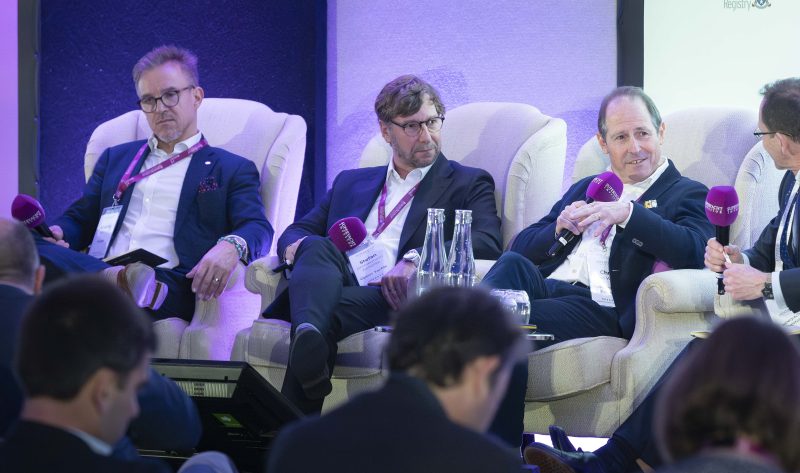
L-R: Anders Kurten, CEO, Fraser; Stefan Zimmermann Zschocke, CEO, Oyster Yachts; Chris Cecil-Wright, founder, Cecil Wright.
One significant headwind that all brokers are facing, certainly for yachts above 60m, is “really good quality stock”, said Cecil-Wright.
He added: “That plays nicely into shipyards that are prepared to invest in stock. Obviously what people want is a boat now, especially if you’re 38 years old, you just made 20 billion.
“We’re finding boats are actually changing hands during construction, sometimes two or even three times as they go up in value. It’s an interesting market; there’s so much demand and so little supply.”
To tap into this burgeoning wealth and differentiate his business, Cecil-Wright said he leans on his network rather than rely on a series of offices around the globe. And he believes the power of relationships offers an antidote to the rise of digital tech and AI.
“Big offices all around the world if you want to rule the world,” he said. “But if you just want to be capable of selling boats and have good information, the network is the important thing … we’re finding all the deals that we’re doing offline are the ones where the value is.”
Sign up for the Superyacht Investor newsletter
With about 230 employees across 21 locations Kurtén and Fraser view the brokerage business model from a slightly different perspective.
“Talking about that circle of trust, I do think that a reasonably wide global footprint is an asset. Especially for sales brokerage, it’s still pretty traditional,” said Kurtén.
He added: “It’s wonderful to have a strong brand. But 98% of the brand value that we have is really the people.”
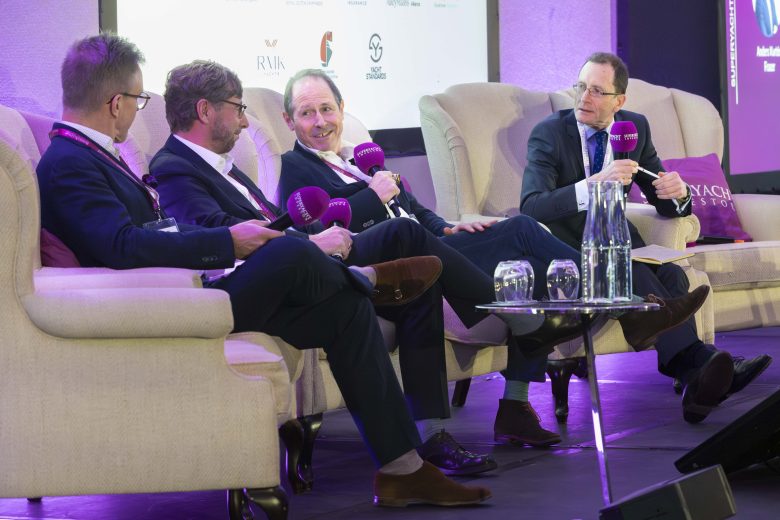
The panel discusses the State of Yachting at Superyacht Investor London 2026.
Kurtén said managing people, finding staff and retaining top talent is “forever” going to be the main challenge, including crewing the growing global fleet.
“You can’t put rookies on a 60m so where do we get all these people with the required 10-15 years’ experience?” he said.
Zimmermann Zschocke conceded the same was true in manufacturing. “Blue sky would be a pan-industry academy where we do craftsmanship,” he suggested.
Cecil-Wright, however, thinks the crew pipeline is “really encouraging”.
“The volume of crew coming in from the hospitality world and the attraction to the industry is very strong. We don’t do crewing and we get 10 CVs a day of new people wanting to get into the industry,” he said.
Human psychology
Looking at other industry headwinds, Kurtén highlighted sustainability and said a focus on new builds with cleaner propulsion would represent a “drop in the ocean” in terms of making yachting greener.
“The installed base is about 7,000 yachts in the 30m-plus range so that’s really where we need to focus,” he said. “The good news is that it’s a simple programme; switch to HVO [hydro treated vegetable oil], favour marinas with green electricity, cruise a little bit slower, knock a knot or a knot-and-a-half off the average cruising speed; negligible effect on the experience, significant effect on the emissions.”
He advocated more people “getting on the bandwagon”, including crew education and the adoption of schemes such as the Yacht Environmental Transparency Index (YETI), not least to mitigate the threat of outside regulation.
“If we don’t show the world and the regulatory bodies that we can clean up the industry, they will do it for us,” he said. “And that’s going to be bad for business.”
Zimmermann Zschocke also said trade regulations in the form of tariffs were a significant challenge, alongside ongoing supply chain issues which will be exacerbated by the conflict in the Middle East. (The panel took place five days after President Trump first launched airstrikes). “Regulation in general, also from an environmental point, is something we’re definitely struggling with from a headwind perspective,” he said.
The panel also pointed to looming issues with the lack of marina infrastructure for the growing global fleet – “where do all these yachts go?” pondered Cecil-Wright.
Returning to the hot topic of tech and artificial intelligence (AI), Cecil-Wright didn’t rule out a situation where transactions are conducted digitally, certainly for charter.
“Absolutely, automation is coming in to a degree,” he said. “It would be so frustrating now to have to make telephone calls to get an airplane ticket. And in 25 years’ time, maybe it’ll be very annoying to have to talk to a broker in order to buy a 90m yacht. Who knows?”
But with that, he pointed out what he sees as the fundamental flaw.
“What we find is that AI really enhances the client experience,” he said. “So by the time they get to us, they’re much more informed than they ever were. They know the questions they want to ask, they know roughly the structure of deals and what’s going to be expected of them and what prices things are.
“But what they don’t know and what AI doesn’t yet do … is it doesn’t know the nuance of the deal. As much as anything it’s the human psychology.”
And that, in the end, is what makes someone buy a superyacht.
Subscribe to our free newsletter
For more opinions from Superyacht Investor, subscribe to our email newsletter.
