
Baltic Yachts’ Hawkins on risk and ‘blunt’ talking
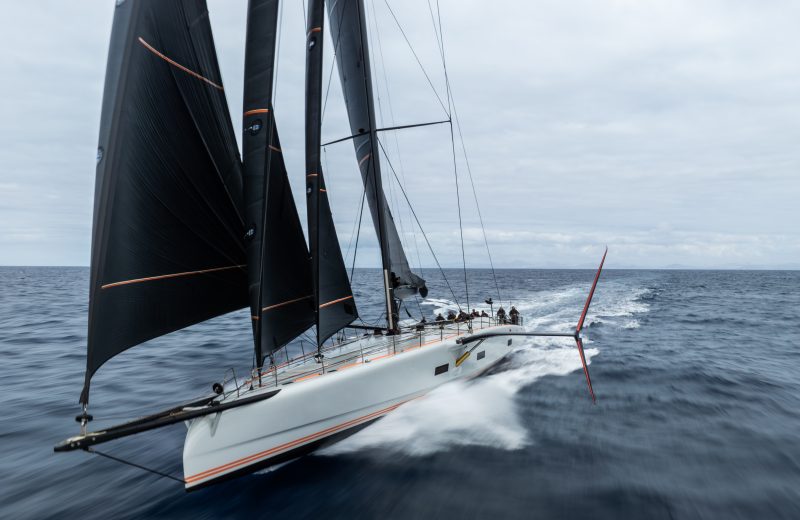
Raven is a Baltic Yachts foil-assisted 34m sailing superyacht. (Photo: Fraser Edwards)
When the client came to see Baltic Yachts, he challenged the team: “Why should I build a boat with you?” The Baltic representatives gave a typically Finnish straightforward answer. There had been other discussions, but the client made the decision to go ahead that afternoon.
Some weeks later, Henry Hawkins, the British executive vice president of Baltic Yachts was chatting to the client. “I asked him how on Earth he made that decision so quickly?” Hawkins tells us.
“He said, ‘In my life, I have to make hundreds of decisions every day. As long as I’m making 51% correct decisions, then I’m a happy person’. I thought, Wow, I spend my life terrified of making one wrong decision.”
Sign up for the Superyacht Investor newsletter
For Hawkins, meeting and getting an insight into the mind of high-achieving individuals is one of the “brilliant” sides to the yachting industry.
“They are a cross section, but they are all supremely driven,” he says. “The ability to make decisions and move on is exceptional.”
Not that every client moves as quickly. Baltic built a 100-plus footer for one couple who had a dream of sailing around the world, but the company had been in discussion with the clients for more than 10 years before Hawkins joined in 2013 and they finally signed about six years later.
“They had a lot of knowledge and had been to a lot of shipyards but they wanted to make sure they got exactly what they wanted at the end of it,” he says.
“I love working with those clients because they’re so fully invested and engaged in it. You know that, by and large, you’re going to end up with a hugely successful project.”

Hawkins spent 18 years at sea before joining Baltic Yachts.
Baltic Yachts was founded by five Finnish boat builders in 1973, intent on producing yachts that are “lighter, stiffer and faster” than the competition. More than 550 boats later, the company now produces innovative, full custom, lightweight composite luxury sailing yachts from 20m to more than 50m from its base in Jakobstad, Finland. At the helm is the Finn Tom von Bonsdorff, who took over as CEO in 2024
In build at the moment is a 32m (107ft) catamaran and a 36m (121ft) sloop, with discussions on everything from 200-plus feet down to 68ft (20m).
“The last couple of years have been fairly positive, fairly buoyant with plenty of inquiries,” says Hawkins. “But the difference between an inquiry and a signature is obviously vast.
“We’re seeing a lot of clients who are still very much active in their own businesses, and when things are turbulent, their minds are on their businesses rather than their leisure time.”
The super sailing yacht market makes up a small fraction of the overall superyacht market – Hawkins puts it at about 14-15% and decreasing, not in numbers but by a “massive” increase on the motor yacht side.
“We’re a little niche and we get more niche year on year,” he says. But he adds that Baltic and its competitors are a “robust bunch” who will keep “shouting loudly” about the benefits of sailing yachts.
“Physically getting people on board and sailing these amazing vessels is not easy. There aren’t that many of them,” he says.
‘Genuine pleasure’
Clients, historically, have been experienced yachtsmen and women, mostly European or American, who go to Baltic direct, already as “experts”. But Hawkins says they are seeing a shift as more non-traditional clients, introduced to yachting through friends or perhaps social media, enter the market. “Gatekeepers” – everyone from a sailmaker, professional sailor or naval architect – are important touchpoints to reach clients.
And he insists there is “genuine pleasure” among all those in the sailing yacht community when new owners sign up, even if with a rival brand, such as when Tom Cruise reportedly bought a yacht from fellow Finnish yard Nautor Swan earlier this year. “At least he’s a sailing man now,” says Hawkins, laughing. “The fact that he’s buying is fantastic.”
Baltic’s first catamaran build, due for launch in 2027, has also brought with it more inquiries from those outside the usual client base as multihulls gain traction.
“If someone asks how much it is per square metre, I know I’m dealing with a very different client to someone who’s coming to me talking about righting moment and sail area,” says Hawkins, who spent 18 years at sea on sailing yachts and built a number of Baltic Yachts with a client before joining the company.

Zemi is a 33.5m Baltic 110 all-carbon sloop with electric propulsion.
As a custom yard, each Baltic Yachts project is fully bespoke with owners bringing their own ideas and appetite for innovation. Collaborations are important; Baltic partnered with aircraft manufacturer Boeing to build a keel on one project.
Take the Baltic 111 Raven, a revolutionary foil-assisted or “skimming” 34m superyacht, which has already won a host of awards.
“Raven is a good example of the reputation of Baltic being able to achieve very complex, unproven projects,” says Hawkins. “With that client, the conversation was, I’ve got this idea, do you think it’s possible? Would you like to work with us to achieve it?”
Then there is Canova, the Baltic 142, with the retractable foil system to reduce heel angle by as much as 34% and pitching by up to 40%.
Integrating the foils was almost the “easiest part” of the project; but like with all cutting-edge designs, the biggest issue is “risk mitigation”, explains Hawkins. Ensuring there is a robust legal framework at the beginning is therefore key to the success of the project.
“It is understanding where the risk lies and where that is apportioned,” he adds. “It doesn’t necessarily need to be a huge amount of legal work. But it needs to be an understanding of what both sides would like to achieve within the framework of the contract. As long as there’s transparency and everyone understands, then you’re in a good place.”
‘On occasion blunt’
Building trust with a client is crucial, and part of that is being honest and challenging their thought process, ultimately for their own good.
“I very much appreciate the Finnish mentality,” says Hawkins. “They are very straightforward, very direct. On occasion blunt. But having straightforward, open conversations and not being afraid to challenge is key.”
A good example of this is a client who was looking to install retractable propulsion into his yacht to reduce drag when sailing, at that time something relatively new to superyachts. Hawkins questioned his intended use profile. Was he planning to campaign the yacht on the regatta circuit, or maybe for cruising around the world, he wondered? The client replied initially he would be onboard six or seven weeks a year, given business constraints.
“I told him there’s a possibility he might not be able to use his boat for three of those six weeks,” says Hawkins.
“That might be an exaggeration. It might not. But we’re bringing complexity into a project. It can break. If it does, it will take time to fix.” Are you prepared to risk three weeks for that gain that you had in performance, Hawkins asked?
“The client said, ‘No, I don’t think I am,’” he adds. “And that boat has not had an engine problem since it launched.”
Unfathomable pace
Another string to the Baltic bow is the refit arm, which makes up about a fifth of the business, either at the yard in Finland or the refit centre in Mallorca. An industry-wide issue, space and the availability of skilled workers are the brakes, as is the ability to maintain quality and control.
“It’s the fastest growing segment of the business,” says Hawkins. “It’s operating at a pace that’s unfathomable.”
With refit as one major growth opportunity, the potential to integrate more foils into superyachting – “they’re definitely coming” – and the opportunities in the catamaran sector are the exciting prospects for the team at Baltic, says Hawkins. Then there is sailing’s pioneering work in green innovation.
“That’s not just a sudden sea change of a hydrogen engine,” he adds. “It’s just everything that we put into the boats and how we run them. There’s genuine desire now to be better.”
For Hawkins, the satisfaction and motivation comes from realising a client’s ideas.
“From that first conversation, it’s truly exciting to understand what the dream is and then matching it,” he says. “It’s absolutely brilliant.”
Subscribe to our free newsletter
For more opinions from Superyacht Investor, subscribe to our email newsletter.
